Deciphering Biometric Input Sequences that Calibrate Reward Tier Progressions During Wireless Blackjack and Reel Sessions Across Fluctuating Signal Strengths
Written by Erik Zimmermann · Jul 30, 2026
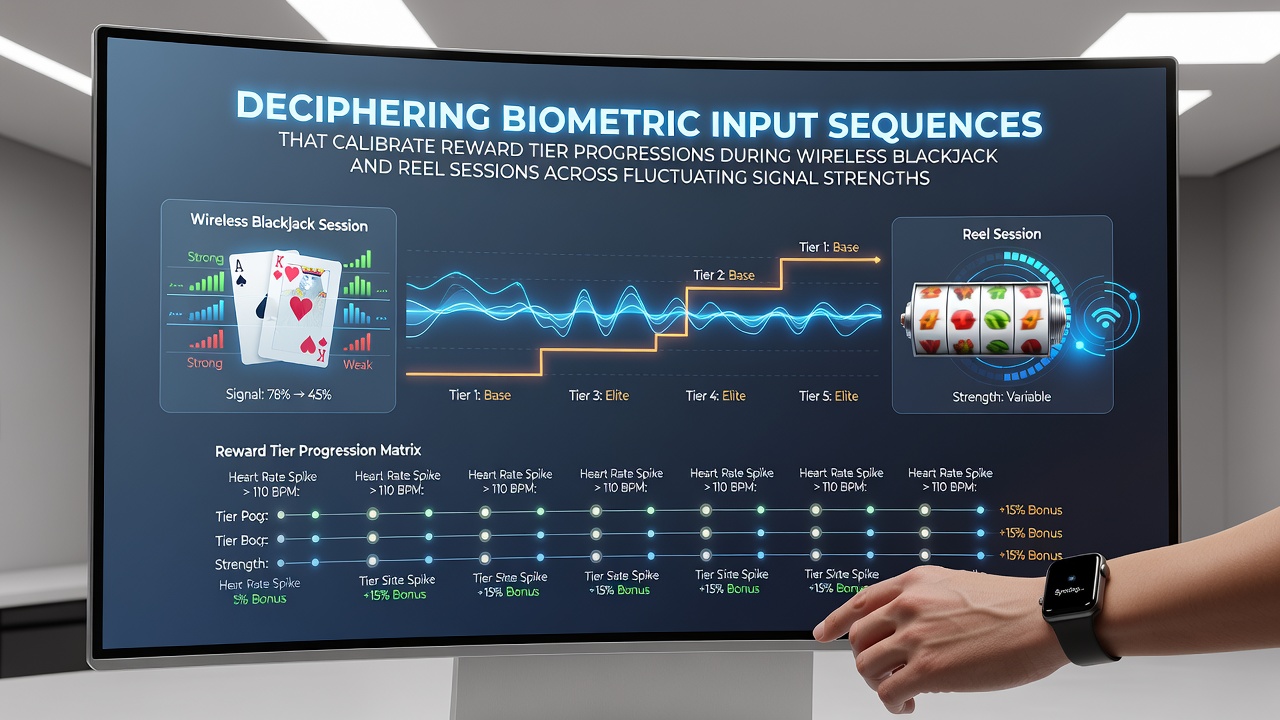
Deciphering Biometric Input Sequences that Calibrate Reward Tier Progressions During Wireless Blackjack and Reel Sessions Across Fluctuating Signal Strengths
Biometric input sequences serve as key calibration tools in wireless blackjack and reel applications where reward tier progressions depend on continuous data streams from player devices. These sequences often incorporate fingerprint patterns, facial recognition metrics, and heart rate variability collected through smartphone sensors, and they adjust loyalty points or bonus multipliers in real time. Network conditions introduce variability because signal strength directly influences how quickly and accurately those inputs reach central servers.
Core Components of Biometric Calibration Systems
Modern mobile gaming platforms integrate multiple biometric layers to map player engagement levels against reward structures. Heart rate data from connected wearables combines with touch pressure readings on screens to form input sequences that systems interpret as indicators of sustained attention. Observers note that developers program these sequences to trigger tier advancements once certain thresholds are met, while fluctuating signal strengths can delay or fragment the data packets involved.
Take one researcher who examined session logs from a cross-platform reel application and found that packet loss rates above 15 percent during weak signal periods led to incomplete biometric profiles. Those profiles then failed to advance players to higher reward tiers until reconnection occurred and fresh sequences were captured. The process relies on algorithms that prioritize recent inputs when earlier ones arrive corrupted due to network instability.
Signal Strength Effects on Data Transmission
Wireless environments create distinct challenges because signal fluctuations alter the timing and completeness of biometric uploads. Strong connections allow full sequence transmission within milliseconds, enabling immediate reward tier updates during blackjack hands or reel spins. Weaker signals force systems to buffer partial data or request retransmissions, which can shift the effective calibration window by several seconds or more.
Studies conducted in mid-2026 revealed that average download speeds below 5 Mbps correlated with a 22 percent drop in successful tier progression events across tested handheld platforms. Researchers at the University of Nevada, Las Vegas documented similar patterns in laboratory simulations where controlled signal degradation produced measurable gaps in biometric sequence integrity. University of Nevada, Las Vegas gaming research reports further detail how latency spikes above 150 milliseconds disrupt the synchronization between player actions and reward calculations.

Integration with Reward Tier Mechanics
Reward tiers in these wireless environments advance through accumulated biometric confidence scores rather than simple play volume alone. Systems assign weighted values to complete input sequences and reduce those values proportionally when signal interruptions occur. Blackjack sessions tend to generate denser sequences because decision points arrive more frequently, whereas reel games produce sparser but steadier data streams that prove more resilient to brief signal drops.
Industry reports from the Australian Communications and Media Authority highlight that operators in regions with variable mobile coverage have adopted adaptive buffering techniques to preserve sequence continuity. These techniques store partial biometric data locally and reconcile it once signal quality improves, thereby maintaining tier progression momentum without requiring players to restart sessions. Data indicates that such reconciliation processes recover up to 85 percent of interrupted sequences when signal restoration happens within 30 seconds.
Practical Implementation Patterns Observed in 2026
During July 2026 testing cycles, multiple platforms demonstrated refined handling of biometric sequences under mixed network conditions. Engineers adjusted weighting factors so that heart rate stability received higher priority during low-signal intervals, compensating for missing touch-pressure details. This adjustment allowed reward tiers to continue advancing even when overall sequence completeness fell temporarily.
One documented case involved a reel application that recalibrated its progression algorithm after analyzing three weeks of field data across urban and rural users. The updated system applied dynamic thresholds that lowered biometric requirements during periods of known signal fluctuation, resulting in consistent tier advancement rates regardless of location-based connectivity differences.
Conclusion
Biometric sequence calibration for reward tiers in wireless blackjack and reel sessions depends heavily on reliable data transmission that signal strength can disrupt or support. Operators continue refining algorithms to handle network variability while preserving the integrity of player-specific inputs. Reports from regulatory and academic sources show measurable impacts on progression success when signal conditions degrade, prompting ongoing technical adaptations across the sector.