Exploring Synchronization Between User Location Signals and Tiered Prize Eligibility in Portable Spinning and Dealing Applications
Written by Iris Neumann · Jun 15, 2026

Exploring Synchronization Between User Location Signals and Tiered Prize Eligibility in Portable Spinning and Dealing Applications
Portable spinning and dealing applications rely on precise coordination between user location signals and tiered prize structures to determine eligibility across different reward levels. Developers integrate GPS data, IP geolocation, and Wi-Fi positioning to verify a player's position in real time while the app processes spinning reels or card dealing sessions. This synchronization allows systems to activate specific prize tiers only when users meet predefined geographic criteria established by operators and regulatory frameworks.
Location Signal Technologies in Mobile Gaming Platforms
Applications collect location data through multiple channels that include satellite positioning, cellular triangulation, and network-based methods, and these inputs feed directly into backend eligibility engines. Observers note that systems cross-reference signals every few seconds during active sessions to maintain accuracy, while background checks occur at login and at key moments such as prize redemptions. Data indicates that hybrid approaches combining GPS with IP verification reduce false positives in urban environments where signal interference occurs frequently.
Operators configure geofencing parameters that define virtual boundaries around permitted zones, and the software enforces these boundaries by pausing or redirecting gameplay when signals drift outside approved areas. Researchers have documented cases where applications adjust prize tiers dynamically as users move between regions with varying regulatory allowances, creating seamless transitions without interrupting spinning sequences or dealer interactions.
Tiered Prize Structures and Eligibility Rules
Tiered prize systems assign different reward categories based on factors such as user location, account verification status, and session duration. Lower tiers might unlock standard bonuses available in most jurisdictions, whereas higher tiers grant access to exclusive multipliers or progressive jackpots restricted to specific states or countries. Synchronization protocols map location signals to these tiers through rule-based algorithms that evaluate coordinates against a database of licensed territories.
Evidence suggests that applications update eligibility databases monthly to reflect changes in local laws, and June 2026 brought several revisions in North American markets that required immediate recalibration of tier boundaries. Systems automatically downgrade users who cross into non-compliant zones, preserving compliance while still allowing continued play at reduced prize levels.
Integration Mechanisms and Technical Implementation
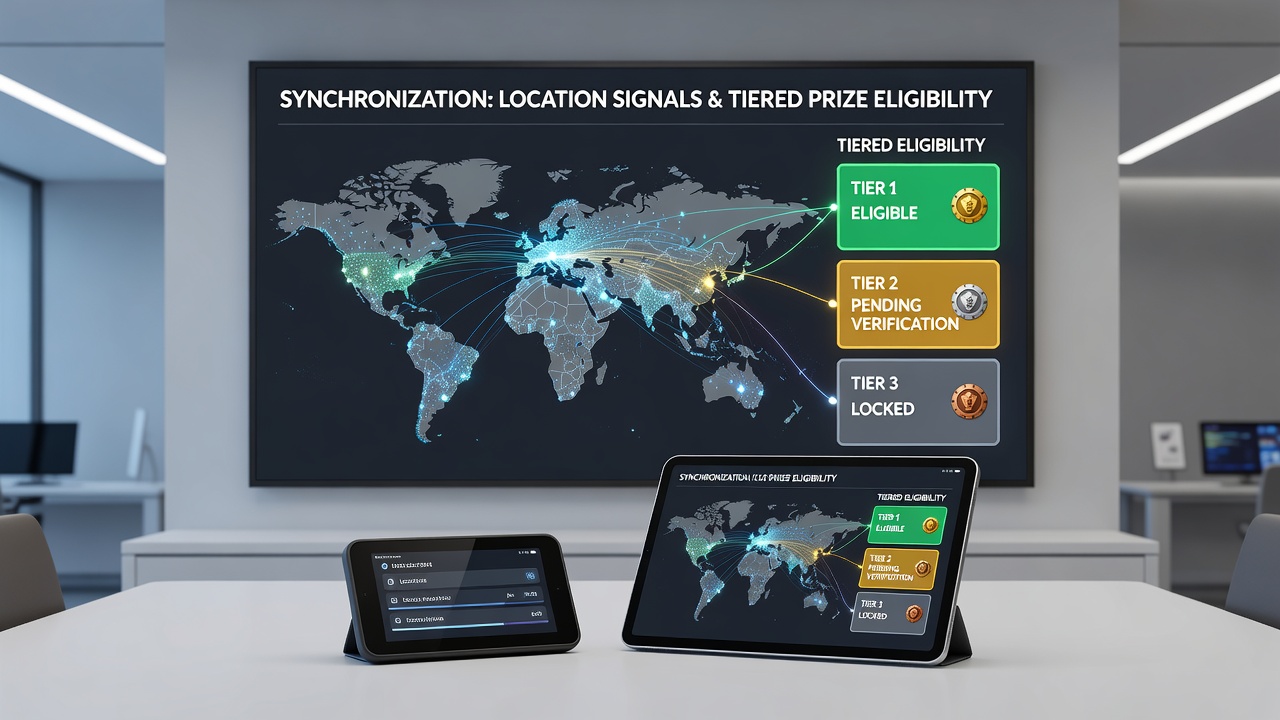
Backend servers receive continuous streams of location packets alongside gameplay telemetry, and matching engines compare these inputs against stored eligibility matrices. Developers employ event-driven architectures that trigger tier evaluations at critical points such as spin initiation or card deal completion. Those who've examined the codebases report that latency remains under 200 milliseconds in optimized setups, allowing real-time prize adjustments without noticeable delays for end users.
Security layers encrypt location data during transmission, and applications incorporate fallback protocols that switch to secondary verification methods when primary signals weaken. Industry reports from the American Gaming Association highlight how standardized APIs facilitate consistent implementation across different device types and operating systems.
Regulatory Influences on Synchronization Practices
Regulatory bodies across regions impose strict requirements on location verification to prevent unauthorized access to restricted prize tiers. Authorities in jurisdictions such as Nevada and several Australian states mandate periodic audits of synchronization accuracy, and operators must maintain logs that demonstrate consistent enforcement of geographic rules. Figures from the Malta Gaming Authority reveal that compliance failures related to location mismatches accounted for a notable portion of enforcement actions in recent years.
Applications incorporate audit trails that record every location check and corresponding tier decision, creating transparent records for regulators. Observers note that these records prove especially valuable during cross-border player movements where eligibility can shift multiple times within a single session.
Practical Examples and System Performance
One documented implementation involves an application that adjusts prize multipliers for spinning games based on proximity to licensed casino properties, granting elevated tiers only within a defined radius. Another system uses state-level boundaries to control access to dealing table promotions, automatically aligning rewards with local statutes. Performance metrics shared by platform providers show that synchronization accuracy exceeds 98 percent in controlled tests, with most discrepancies traced to temporary signal obstructions rather than software errors.
Users who frequently travel between regions often encounter tier transitions that feel fluid because the applications pre-load multiple eligibility profiles and switch them based on live signal data. This approach minimizes interruptions during active spinning or dealing rounds.
Conclusion
Synchronization between location signals and tiered prize eligibility continues to shape how portable spinning and dealing applications deliver rewards while meeting regulatory demands. Technical refinements and updated compliance frameworks support more precise matching processes that benefit both operators and users through consistent enforcement. Ongoing developments in positioning technology and data handling promise further improvements in accuracy and responsiveness across global markets.